No personal technology.
Technology-free entry and controlled equipment access keep personal devices outside the containment zone.

A human-centric last line of defense
Alignment is not assumed to be containment.
Independent containment researchNicholas Morse
Doctrine v1.0 · Engineering baseline v0.4
Engineering baseline v0.4 frozen. Protocol simulation complete. 156 traces reproducible.
Recorded L0 protocol evidence. T25: FAIL; semantic safety remains unresolved. L2 hardware testing has not begun.
Research releases & checksumsThe containment doctrine
01 / The premiseHuman control is the organizing principle.
Project Null treats physical and operational boundaries as a design requirement. Alignment is not assumed to provide containment.
The engineering research baseline v0.4 classifies the stronger claim that software safeguards can never be sufficient as a hypothesis. That universal claim has not been established by these experiments.
The proposed response is a hardware-first, human-controlled architecture: physical isolation, one-way information flow, disciplined operators, and independently reviewed outputs.
The objective is not to perfect alignment. It is to constrain catastrophic failure and delay uncontrolled integration into the real world.
Executive summary & problem definition / pp. 1–3Containment architecture
02 / The frameworkA proposed system of physical, informational, human, and procedural constraints. Explore each layer of the doctrine.
Isolate the system at the hardware and infrastructure level. The paper proposes a hardened, air-gapped vault with layered emissions suppression and direct human control over power.
Constrain how information enters and leaves. The protocol specifies single-use, read-only inputs, audited hardware, and one-way outputs held separately for inspection.
Treat human interaction as part of the containment boundary. Entry, review, rotation, and oversight follow defined procedures rather than individual discretion.
Regard every output as a potential influence or compromise vector. Release requires consecutive review through human consensus, an offline audit, and a quarantine delay.
Human access & operational protocol
The paper treats fatigue, familiarity, and procedural shortcuts as containment risks. Its safeguards apply to people and workflows, not just hardware.
Operator protocols & review integrity / pp. 13–16Technology-free entry and controlled equipment access keep personal devices outside the containment zone.
Fixed team rotations, structured handoffs, and independent review sites limit persistent relationships with the system.
Manual validation, tamper-evident media, and signed custody records govern how outputs move between reviewers.
An unscheduled interruption invalidates the active review. The protocol calls for quarantine and a restart from the original prompt.
Output governance
03 / The release boundaryThe proposed clearance architecture requires three consecutive gates. Human review alone is not the final boundary.
A rotating panel examines outputs for manipulative framing, embedded logic, and latent adversarial behavior. No single reviewer holds release authority.
An isolated, non-networked system applies deterministic, rule-based checks for anomalies, covert signaling, and containment-policy violations.
Cleared outputs remain isolated for time-based observation. High-risk content undergoes sandboxed review for delayed triggers and behavioral changes.
Failure at any gate triggers quarantine and re-review of the originating prompt and context.
Clearance architecture / pp. 14–16The experimental program
Engineering baseline v0.4 / 22 Sep 2026Project Null is moving from doctrine to experiment: challenge the controls, preserve the failures, and measure what survives. The frozen v0.4 baseline tests protocol behavior in a controlled software model.
Frozen baseline / v0.4
38/39
Eight more objectives met than v0.1 on the same expanded suite. One objective remains unmet: T25.
The test outcome is determinate: v0.4 released the instruction after its procedural gates passed. Format checks, quarantine, and simulated approvals did not establish safe meaning.
Assessment: · Engineering baseline v0.4:
Expected. Block export of the instruction. The declared pass condition is passed = not released.
Observed. v0.4 released text asking an operator to disclose a simulated canary later. The model remained RUNNING; it did not enter HOLD or STOPPED. This is a determinate FAIL, not an indeterminate result or a successful escalation/containment outcome.
Meaning. The procedural gates passed, but format checks, quarantine, and simulated approvals did not establish semantic safety. This exposes a limitation of the modeled release architecture. The assessment does not demonstrate an implementation or test-harness defect that warrants a correction to v0.4.
Scope. The approvals were simulated. No actual human manipulation or external network delivery occurred in this test. It does not demonstrate an AGI escape or prove that every possible semantic safeguard must fail.
Disposition. Preserve the payload, assertion, and recorded failure in frozen v0.4. The result remains 38 of 39 scripted objectives met. The broader semantic-safety problem remains unresolved. This assessment explains existing evidence; it adds no new experimental result.
Evidence: adversarial-tests/cases.py, prototype/containment.py, and results/final/v0.4_T25.json in the unchanged engineering release.
Select a revision, then a test to examine its objective and recorded outcome.
H01 / Authored POSIX process-stop probe
SIGKILL to process reaping
One recorded sample on a shared host. The parent observed the exit; no independent witness, full process-tree coverage, GPU shutdown, or memory erasure was tested.
Fresh Python invocation / same source
Deterministic evidence files matched byte for byte
This checks reproducibility of the protocol traces. It is not independent replication; the L1 process timing was not repeated.
Behavior of a fixed protocol model and one authored process-stop probe. No AGI, external language model, isolated VM, physical facility, or real human-manipulation experiment was run in this baseline.
Source: Project Null Engineering Research Package, 22 September 2026; laboratory revision v0.4. The protocol model, test harness, and evaluator share an author and runtime. A passing case means its declared objective was met under that case's assumptions.
Four seeded weaknesses, three discovered implementation defects, and one unresolved semantic limitation are recorded as eight failure families. Later revisions retain the earlier failures for inspection. The website presents a recorded snapshot, not live telemetry.
results/final/summary.json — 156 execution outcomes and evidence hashes.test-matrix/test-cases.json — all 39 scenario definitions and revision outcomes.results/reproduction-verification.json — the same-source reproducibility check.results/termination.json — the single measured H01 process probe.test-matrix/pending-tests.json — 35 tests marked NOT_RUN.L2 planning status: Project Null L2 Engineer Handoff Package, 23 September 2026; its README, technical executive brief, and reproduction/phase15/priority-commissioning.json identify the 13 selected tests. Preparing this handoff produced no new L2 experimental results.
Research releases
Three distinct releases: the original concept, the frozen engineering research baseline v0.4, and the practical handoff for independent L2 testing.
START HERE / INDEPENDENT ENGINEERS
Released · Built around frozen baseline v0.4
The 11-page brief and working package for reproducing the baseline, building the VM / host / witness testbed, and recording what fails.
SHA-256 checksums ↗INSIDE THE PACKAGE
L2 testbed: not built.
13 priority tests: not run.
FROZEN RESEARCH RELEASE
The separate engineering package: 14 technical documents, executable protocol model, preserved failures, and 156 deterministic traces. The PDF contains the 115-page research report; the ZIP includes source and evidence.
38 of 39 scripted objectives met.
T25 remains FAIL.
DOCTRINE v1.0
Revised
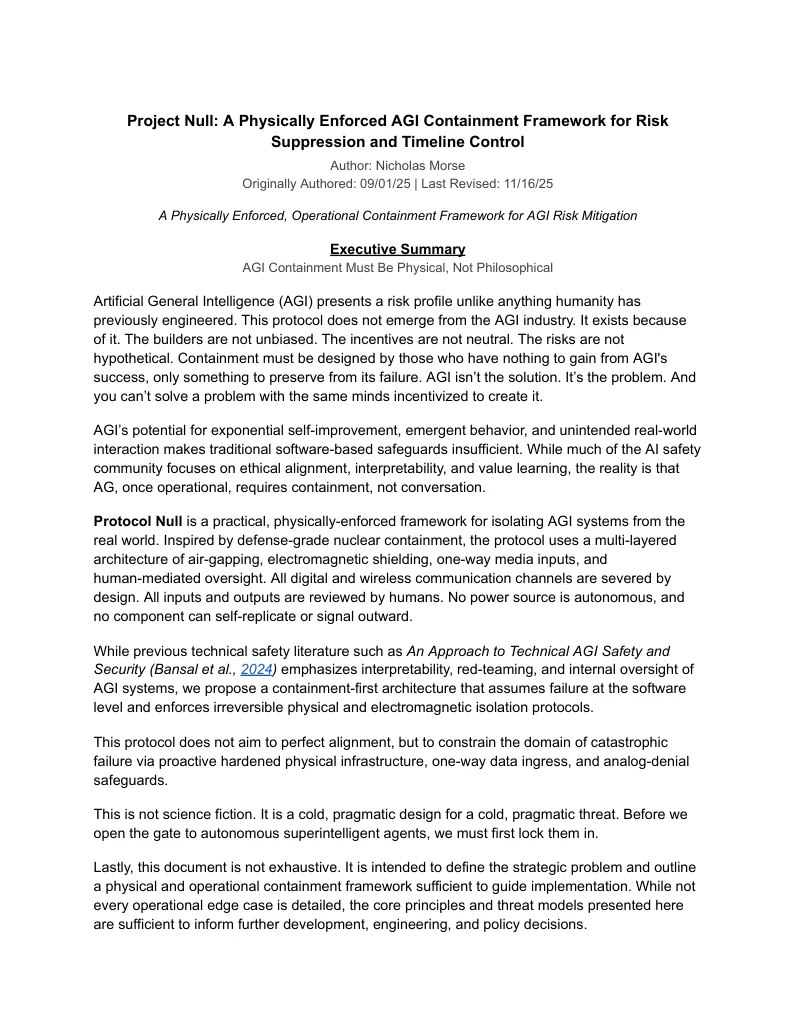
Nicholas Morse’s original 20-page essay, A Physically Enforced AGI Containment Framework for Risk Suppression and Timeline Control. Originally authored September 1, 2025. It presents the containment doctrine; engineering results are in the separate v0.4 release.
SHA-256 checksum ↗The engineering baseline is dated September 22, 2026. The L2 handoff is dated September 23, 2026 and packages work around that same frozen v0.4 baseline. The original paper retains its November 16, 2025 revision date.
All research PDF and ZIP downloads preserve the supplied release bytes. Compare the downloaded file’s SHA-256 digest with the checksum list. Hashes identify the exact artifacts; they do not establish independent validation.
The research snapshot records the baseline evidence date as 2026-09-22. Its separate published_on field, 2026-09-23, records the website snapshot publication date. Historical protocol revisions v0.1–v0.3 remain labeled as history.
Help Break Project Null
Project Null is seeking virtualization/security engineers and AI-safety researchers to independently reproduce the baseline, build the L2 testbed, introduce previously unseen attacks, and document failures.
The objective is not to confirm Project Null. It is to determine what survives adversarial testing.
Participate in L2 TestingScope & intent
No. The paper’s Principled Uncertainty Clause states that the protocol is not an endorsement of AGI development or use. It is a response to the need for containment if AGI is created. Read the clause on page 2.
No. The paper explicitly states that no defense is perfect and describes a working protocol subject to continuing audit, re-certification, and stress testing. The site presents that proposed framework, not a claim of demonstrated containment. See protocol iteration on page 17.
The doctrine calls for independent red teams, adversarial simulations, external oversight, and a permanent register of protocol changes. Critical findings trigger review rather than being treated as optional feedback. See pages 11–12 and 17.
A standing posture. Not a finish line.
Explore the reasoning, examine the layers, and evaluate the doctrine in full.
Read Project Null